> Documentation index: https://docs.hodeishield.com/llms.txt
# Core concepts
## The supply-chain graph
HodeiShield models your third-party ecosystem as a directed graph, not a flat list:
| Element | Description | Example |
|---|---|---|
| **Node** | An entity: vendor, product, or your own organization | `Cloud provider X` |
| **Edge** | A dependency relationship between two nodes | `Your app` depends on `Cloud provider X` |
| **Weight** | The strength of the dependency, used to propagate risk | Critical = 1.0, support = 0.3 |
An incident on one node doesn't stay isolated: it propagates along edges by weight, so a
fourth-party's risk (your vendor's own vendor) can also reach your score.
## Dependency types
| Type | Impact if it fails |
|---|---|
| **Critical** | Interrupts service or exposes sensitive data |
| **Operational** | Degrades a function, without full interruption |
| **Support** | Limited, usually reversible impact |
| **Sub-processor** | Processes data on behalf of a direct vendor |
| **Reseller** | Commercial intermediary, no direct technical access |
## Criticality
Each vendor gets a criticality level (**critical / high / medium / low**) that multiplies
its risk score and decides how often it gets re-scanned.
## Systemic risk
When several critical vendors depend, in turn, on the same fourth party, that fourth party
concentrates a risk no single direct relationship shows on its own. HodeiShield surfaces
this concentration explicitly in the graph, instead of hiding it behind N independent
scores.
## How the risk score is computed (0–100)
| Component | Weight | Source |
|---|---|---|
| Security scan | 35–50% | Automated scan result |
| Questionnaire | 25–40% | Vendor self-assessment |
| Known CVEs | 20–35% | Vulnerabilities in declared assets |
When one component is missing, the weights of the others rise: for example, with only CVE
data the CVE component weighs 60%. The base score is adjusted with modifiers: vendor access
level (the final score is multiplied by 1.3 for critical access, 1.15 for high, 1.0 for
medium and 0.85 for low), time since the last re-scan, risk propagated from the vendor's own
dependencies, active certifications (which reduce it), and dependency concentration on a
single fourth party.
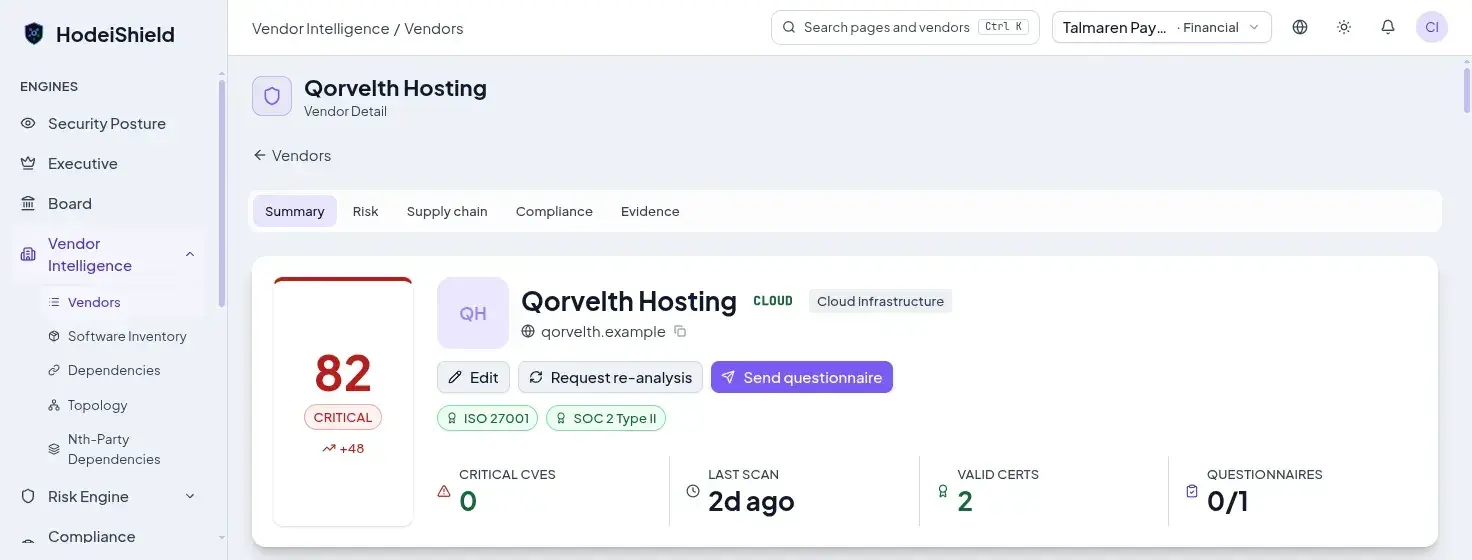
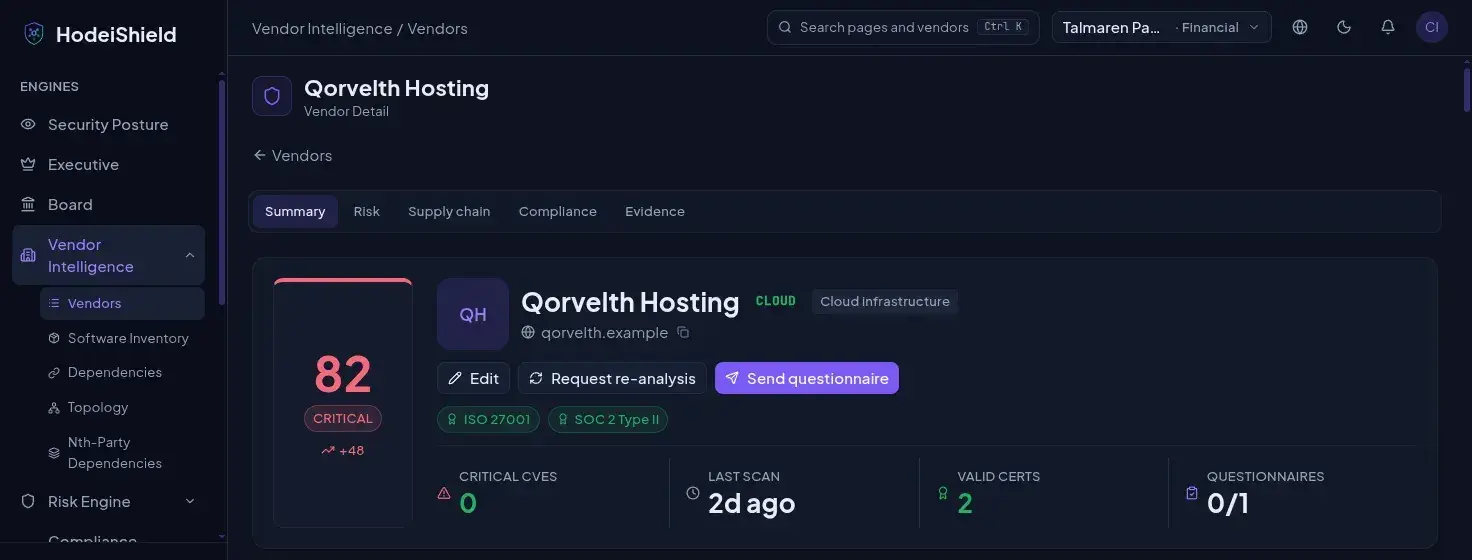
A vendor's summary card: composite score, severity band, valid certifications, and
critical CVE count.
## Next step
- [Risk engine](https://docs.hodeishield.com/en/product/risk-engine/) — from the score to financial exposure.
- [Getting started](https://docs.hodeishield.com/en/guides/getting-started/) — add your first vendor.